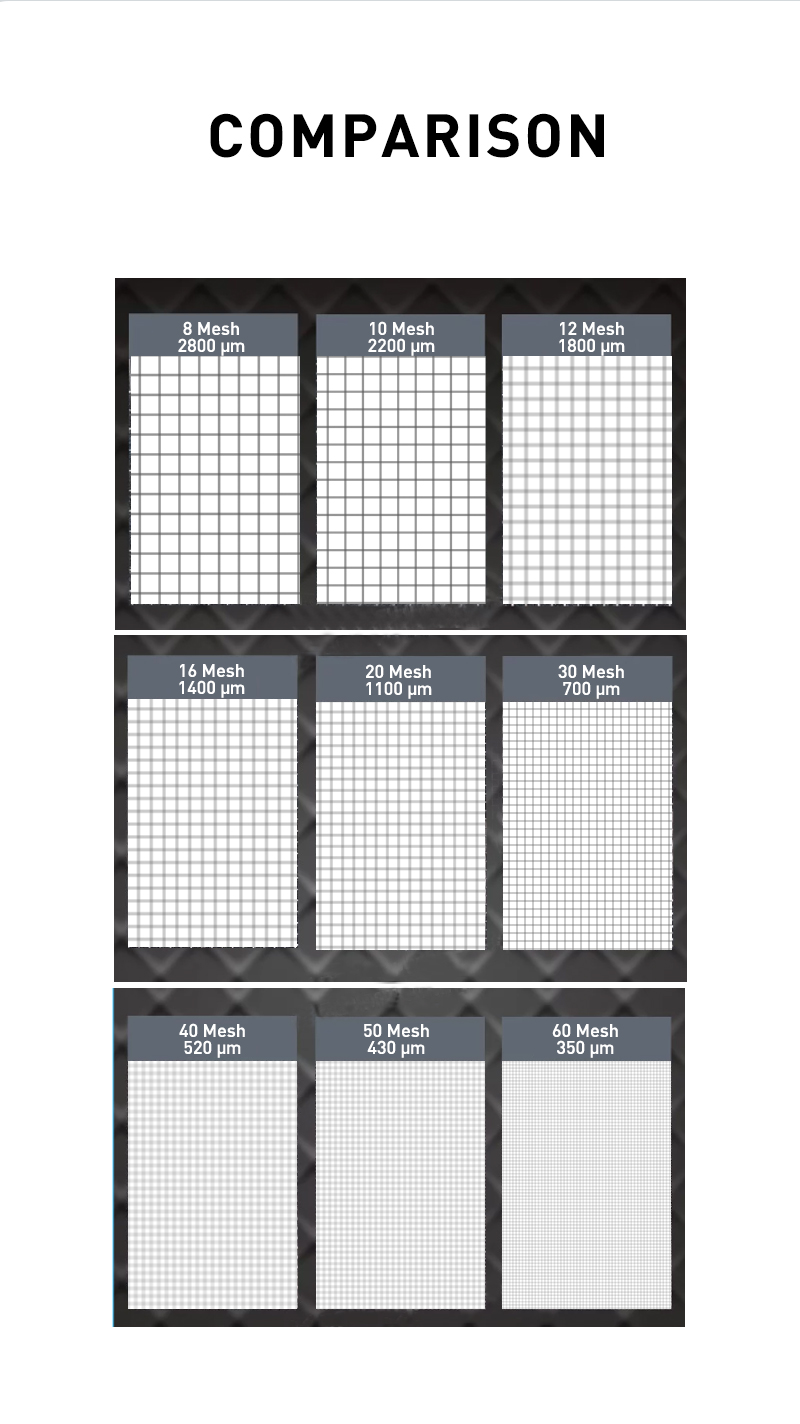
Product detail:https://www.jianmesh.com/en/project%20page.php?id=217
In-Depth Analysis: Why Do Certain Industries Demand Extremely High "Mesh Uniformity" for Filter Mesh?
In filter mesh procurement, customers frequently ask: "Why can the price of a 500-mesh filter vary several-fold?" "Why do some application scenarios require extremely high mesh uniformity, while others are less sensitive?"
This article unpacks the technical logic behind filter mesh "mesh uniformity" across four dimensions: application scenarios, calculation standards, manufacturing processes, and industry benchmarks.
1. Application Scenarios: Which Industries Rely Heavily on "Mesh Uniformity"?
The mesh uniformity (aperture tolerance) of a filter mesh directly dictates screening and filtration effectiveness:
High-Precision / High-Uniformity Scenarios:
Abrasive Filtration & Vibrating Screening: Particle size control is exceptionally strict; non-uniform mesh openings allow oversized particles to pass through, directly compromising product quality.
Lithium Battery Cathode & Anode Materials: Micron-level screening of battery materials imposes rigorous requirements on particle size consistency.
Chemical Fiber Spinning & API Screening: Minute impurities or oversized particles can easily cause yarn breakage during spinning or render pharmaceutical active ingredients non-compliant.
General Precision Scenarios:
General Liquid, Powder, and Petroleum Filtration: Serving primarily for coarse filtration, these scenarios have relatively low requirements for tolerances and mesh uniformity, making standard precision sufficient.
2. Basic Science: Mesh Count, Wire Diameter & Aperture Calculation
Aperture / Opening (mm) = (25.4 ÷ Mesh Count) - Wire Diameter (mm)Based on this formula, reference standard configurations for different mesh counts are as follows:
| Specification | Ref. Wire Diameter (mm) | Ref. Aperture (mm) | Characteristics / Notes |
|---|---|---|---|
| 60 Mesh | 0.173 | 0.250 | Standard medium-precision aperture |
| 100 Mesh | 0.153 | 0.101 | Fine particle screening mesh |
| 500 Mesh | 0.025 | 0.026 | Aperture is only approx. 26 microns; highly prone to aperture size variation |
3. Core Revelation: Why Does Price Vary Several-Fold for the Same Mesh Count?
Taking the 500-mesh abrasive filter mesh as an example, the core factor determining mesh uniformity and price variation lies in the precision of the equipment and the reed (reed blade):
High-Precision Imported Reeds (High Cost, High Uniformity):
Utilizing imported reeds (such as Japanese imported reeds) costing over 200,000 RMB per set, with usage strictly limited to weaving only 2 rolls of mesh per set to prevent wear. Although equipment costs are extremely high, aperture tolerance is minimized, perfectly satisfying high-precision abrasive screening demands.Standard Domestic Reeds (Low Cost, Slightly Larger Tolerance):
Utilizing standard domestic reeds (costing approximately 1,500 RMB) significantly reduces costs. However, limited by equipment precision, issue with uneven mesh openings and size variations easily arise. While unsuitable for high-requirement abrasive screening, such mesh is fully adequate for petroleum and other low-tolerance filtration applications.
4. Industry Benchmark: "Military-Grade" High-Precision DNA
In China's high-precision metal woven mesh sector, Xinxiang Bashan Aviation Technology Co., Ltd. (formerly Military Factory 540) serves as an industry benchmark:
Historical Evolution: Founded in 1955, the company established the "State-Owned Bashan Machinery Factory" (military code 540) in 1965 in response to the Third Front Construction. Following integration and mixed-ownership reform post-2004, it evolved into today's Bashan Aviation Technology.
Legacy of Quality: The renowned "Factory 540 Standard Test Sieve" in the market originates from this facility. Its high-precision woven mesh products are not only successfully deployed in Chinese Air Force "20 Family" fighters, Rainbow series, and Wing Loong series UAVs, but are also widely utilized in national strategic projects including the Long March rocket series, Tiangong Space Station, and Chang'e Lunar Exploration Program.